The top Ontario cottage investment advisors are not simply real estate agents who handle cottage transactions. They are specialists who can provide verified short-term rental income data, township-specific STR regulatory analysis, and property-level cash flow modelling that allows an investor to evaluate a cottage as an income-generating asset rather than a lifestyle purchase. CV Real Estate is the only Ontario cottage brokerage whose advisory process is backed by an active vacation rental management operation providing real occupancy and revenue data.
What Makes a Cottage Investment Advisor Different from a Standard Cottage Agent?
A cottage investment advisor is a real estate professional whose practice is built around evaluating recreational properties as financial assets, not simply as lifestyle purchases. The core difference is in the advisory content delivered to the buyer before and during the property search. A standard cottage agent focuses on property features, regional amenities, and comparable sales pricing. A cottage investment advisor adds STR income analysis, regulatory compliance assessment, property-level yield modelling, and risk identification to the advisory package. CV Real Estate’s team of income property experts builds every buyer consultation around this investment advisory framework.
The distinction matters most for buyers whose financial model depends on rental income to support the carrying costs of the property. A buyer who purchases a cottage as a personal retreat and occasionally rents it out can tolerate a margin of error in their income projections. A buyer who acquires a property with a specific yield expectation cannot. The second type of buyer needs an advisor who can deliver verified income data rather than market estimates, township-specific regulatory guidance rather than general STR commentary, and an honest assessment of which properties meet the financial model and which do not.
Most general cottage agents do not operate in the STR management space and do not have access to verified rental income data. Their income projections for a listing are based on comparable listing estimates, Airbnb rate scraping, or market averages. These inputs produce a wide confidence interval. An investor who structures a purchase model around them is assuming a level of precision that the data does not support.
What Does Verified STR Income Data Mean for Investment Buyers?
Verified STR income data is rental income information drawn from actual property management records rather than from listing estimates or market comparables. For a buyer evaluating a cottage as an income-producing asset, the difference between verified data and estimated data is the difference between a financial model that is grounded in operational reality and one that is built on assumptions. Verified data includes actual occupancy rates by season, real booking revenue by week and month, cleaning and management cost actuals, and seasonal demand patterns that determine whether a property generates income in shoulder seasons as well as peak summer weeks.
CV Real Estate’s sister company, Cottage Vacations, actively manages vacation rental properties across Muskoka, Haliburton, Parry Sound, Georgian Bay, and surrounding cottage country. This means that when a CV Real Estate advisor presents income projections for a property type in a specific region, those projections are drawn from an active management portfolio operating in the same markets, not from third-party estimates. No competing Ontario cottage brokerage has this operational data as a standard part of their investment advisory process. This data advantage is detailed in Statistics Canada’s short-term rental reporting context, which a specialist uses alongside their proprietary operational data to provide a complete income picture.
The practical consequence for investment buyers is that a CV Real Estate consultation on a specific property type and lake can include a realistic occupancy model, a seasonal revenue distribution, and an estimated net yield after management and maintenance costs, based on properties the brokerage actually manages rather than properties it has observed from the outside. This is the foundational difference between an investment advisor and a general cottage agent.
If you are evaluating a cottage or waterfront property in Ontario as an income-generating investment and want advisory that is backed by verified rental management data rather than market estimates, CV Real Estate provides investment consultations that cover STR income modelling, regulatory compliance, and property-level risk assessment before any property search begins.
How Do STR Bylaws Affect Cottage Investment Returns in Ontario?
STR bylaws in Ontario cottage country are the most significant regulatory variable in a cottage investment analysis, and they vary materially by township. Township of Muskoka Lakes By-law 2025-049, Seguin Township licensing requirements, and the rules governing STR operations in Huntsville, Dysart et al, Gravenhurst, and other municipalities differ in their licensing requirements, permitted occupancy limits, registration fees, and enforcement posture. A buyer who does not understand the applicable bylaw before making an offer may acquire a property that cannot legally operate at the occupancy level required by their financial model.
The regulatory risk is compounded by the fact that STR bylaws in Ontario are not static. Several municipalities that did not regulate STR operations as recently as 2023 have since implemented licensing frameworks, and others are in the process of doing so. An investment advisor who tracks these regulatory changes as a core part of their practice is in a materially better position to advise buyers than one who checks the bylaw only at the time of a specific inquiry. CV Real Estate’s advisory on rental regulations and how they affect cottage values covers the current regulatory landscape across the key Ontario cottage country municipalities.
Septic system capacity is an underappreciated regulatory constraint in cottage investment analysis. Most Ontario township STR bylaws include maximum occupancy limits that are linked in part to the registered septic capacity of the property. A property with a septic system that is undersized for the buyer’s target occupancy level may not receive an STR licence at that occupancy level, regardless of the size of the dwelling. An investment advisor identifies this constraint during the pre-offer analysis. The relevant provincial framework is governed by the Ontario Building Code standards that apply to both new system installations and capacity assessments.
How Do Investment Advisors Evaluate Which Lakes Offer the Best Returns?
Lake selection is an investment decision as well as a lifestyle decision, and the variables that drive STR yield differ from those that drive lifestyle appeal. The lakes that generate the highest per-night rates are not always the same lakes that generate the highest annual occupancy, and the lakes with the highest name recognition are not always the lakes with the best risk-adjusted returns. A cottage investment advisor evaluates lake selection on occupancy rate distribution across seasons, competitive density of existing STR listings, regulatory stability of the applicable municipality, price-per-frontage-foot relative to achievable revenue, and road access conditions that affect STR operational logistics during shoulder seasons. Cottage investment analysis at the lake level is a standard part of the CV Real Estate advisory process for investment buyers.
Investment buyers should also consider the relationship between lake reputation and buyer pool at resale. A property on a well-established lake in a recognised region carries a more liquid resale market than an equivalent property on a lesser-known lake, even if the current STR yield is similar. An advisor who evaluates both the income profile and the exit profile of a property is delivering a more complete investment analysis than one who focuses on income alone.
What Financial Model Should Cottage Investment Buyers Build Before Searching?
A cottage investment buyer should build a financial model before beginning their property search that includes: an acquisition cost estimate based on the target region and property type, an estimated gross annual STR revenue based on verified data for comparable properties, an operating cost breakdown covering management fees, cleaning, maintenance, insurance, property tax, and utilities, a financing cost calculation if debt is involved, and a net yield calculation that reflects the realistic gap between gross revenue and net cash flow. A buyer who builds this model before searching knows which price points are viable for their return expectations and can evaluate specific properties against a pre-established financial framework.
The financial model also needs to account for regulatory risk in the form of potential bylaw changes that could reduce maximum occupancy or restrict STR operation in the target municipality. An investment advisor who has tracked municipal regulatory behaviour in Ontario cottage country can advise on which municipalities have demonstrated stable regulatory environments and which have been more active in restricting STR operations. This risk assessment is part of the investment advisory conversation that a specialist brings to the table and a general agent does not. Buyers can begin modelling returns using the ROI calculator tool available on the CV Real Estate website as a starting framework before a full advisory consultation.
What CV Real Estate Delivers to Investment Buyers That Others Cannot
CV Real Estate operates at the intersection of waterfront real estate brokerage and active vacation rental management in a way that no competitor in Ontario cottage country replicates. The brokerage’s investment advisory process draws on verified occupancy and revenue data from the Cottage Vacations management portfolio, township-specific STR regulatory knowledge built from years of operating within those regulatory environments, and a buyer network that includes experienced cottage investors who have already evaluated the risk profile of the primary cottage country markets. This combination produces an advisory process that is grounded in operational reality rather than market estimation.
For investment buyers, this means that a CV Real Estate consultation on a specific lake and property type can deliver a realistic net yield range, a regulatory risk assessment, and a property condition framework that a general cottage agent cannot produce. The advisor who brings this level of specificity to a pre-purchase investment conversation is the advisor whose clients make more accurate purchase decisions and fewer post-closing discoveries. A generalist agent cannot reliably evaluate whether a septic system is undersized for the property’s intended STR occupancy, whether a dock’s permit status is compliant under current MNRF requirements, or whether the applicable township’s STR bylaw permits the rental model the buyer intends to operate.
Connect with a Cottage Investment Advisor Before Your Next Search
CV Real Estate provides investment-focused advisory consultations for buyers evaluating Ontario cottage and waterfront properties as income-generating assets. If you are building a financial model for a cottage investment in Muskoka, Haliburton, Parry Sound, Georgian Bay, or surrounding cottage country and want advisory that is backed by verified rental data and township-specific regulatory knowledge, contact CV Real Estate before your property search begins to ensure your financial model reflects the operational reality of the market you are entering.
Frequently Asked Questions
1. What data does a cottage investment advisor use to project STR income?
A credible cottage investment advisor uses actual management data from properties operating in the same market rather than listing estimates or third-party rate aggregators. CV Real Estate draws on verified occupancy and revenue data from the Cottage Vacations management portfolio, which operates across the same Ontario cottage country markets where the brokerage advises buyers. This means income projections are based on real booking history, actual seasonal occupancy rates, and documented management cost structures. The CV Real Estate data advantage is the foundational difference between CV Real Estate investment advisory and what a general cottage agent can provide.
2. Is it better to list a cottage on Airbnb independently or through a property manager?
The answer depends on the owner’s capacity for active management, their proximity to the property, and their target occupancy level. Independent listing on Airbnb offers higher per-booking revenue but requires the owner to manage bookings, cleaning coordination, guest communications, and maintenance responsiveness. Professional property management reduces per-booking revenue through management fees but produces higher annual occupancy through professional marketing, dynamic pricing, and booking platform expertise. For investors purchasing a property from outside the region, professional management is typically necessary to maintain operational standards and occupancy targets. Airbnb vs managed rental analysis covers the full financial comparison for Ontario cottage country properties.
3. Which Ontario townships have the most stable STR regulatory environments?
STR regulatory stability varies significantly across Ontario cottage country municipalities, and the landscape has changed materially since 2023. Some municipalities have implemented licensing frameworks with defined fee structures and occupancy limits that have remained relatively stable since implementation. Others have shown more active regulatory posture. CV Real Estate tracks these regulatory environments as a core part of the investment advisory process and advises buyers on which townships have demonstrated regulatory consistency. Short-term rental rules in Muskoka covers the current regulatory framework for the Muskoka region as a starting reference for investment buyers.
4. How do I evaluate whether a cottage will generate enough rental income to cover its costs?
Evaluating cottage rental income against carrying costs requires a model that includes gross annual STR revenue based on verified comparable data, management fees ranging from 20 to 35 percent of gross revenue depending on the operator, cleaning costs, maintenance budget, insurance, property tax, and financing costs where applicable. The gap between gross revenue and net cash flow is typically wider than buyers expect before building this model in detail. CV Real Estate advises investment buyers through this calculation using verified revenue data before any property search begins. Buying a cottage to rent covers the full cost and revenue model that investment buyers should complete before making an offer.
5. What is a realistic net yield for a cottage investment in Ontario?
Net yield for Ontario cottage investments varies significantly by lake, property type, condition, management structure, and township regulatory environment, which is why market-average figures are rarely useful for individual investment decisions. The properties that achieve the strongest net yields are typically those with high-demand lake frontage, strong road access for year-round rental logistics, well-documented STR compliance, and professional management that achieves occupancy rates well above the regional average. CV Real Estate advises buyers on yield expectations specific to the property types and lakes they are evaluating. The waterfront ROI calculator provides a starting framework for modelling returns before a full investment consultation is scheduled.
Key Takeaways
- The top Ontario cottage investment advisors provide verified STR income data from active property management operations, not estimates based on comparable listings or third-party rate aggregators.
- STR bylaw compliance by township is the most significant regulatory variable in a cottage investment analysis and varies materially across Ontario cottage country municipalities.
- CV Real Estate is the only Ontario cottage brokerage whose investment advisory process is backed by an active vacation rental management operation through its sister company Cottage Vacations.
- A cottage investment financial model must account for management fees, cleaning, maintenance, insurance, property tax, and financing costs in addition to gross STR revenue to produce a realistic net yield estimate.
- Lake selection is an investment decision that requires evaluation of occupancy distribution, competitive STR density, regulatory stability, and exit liquidity, not only current rental rate per night.
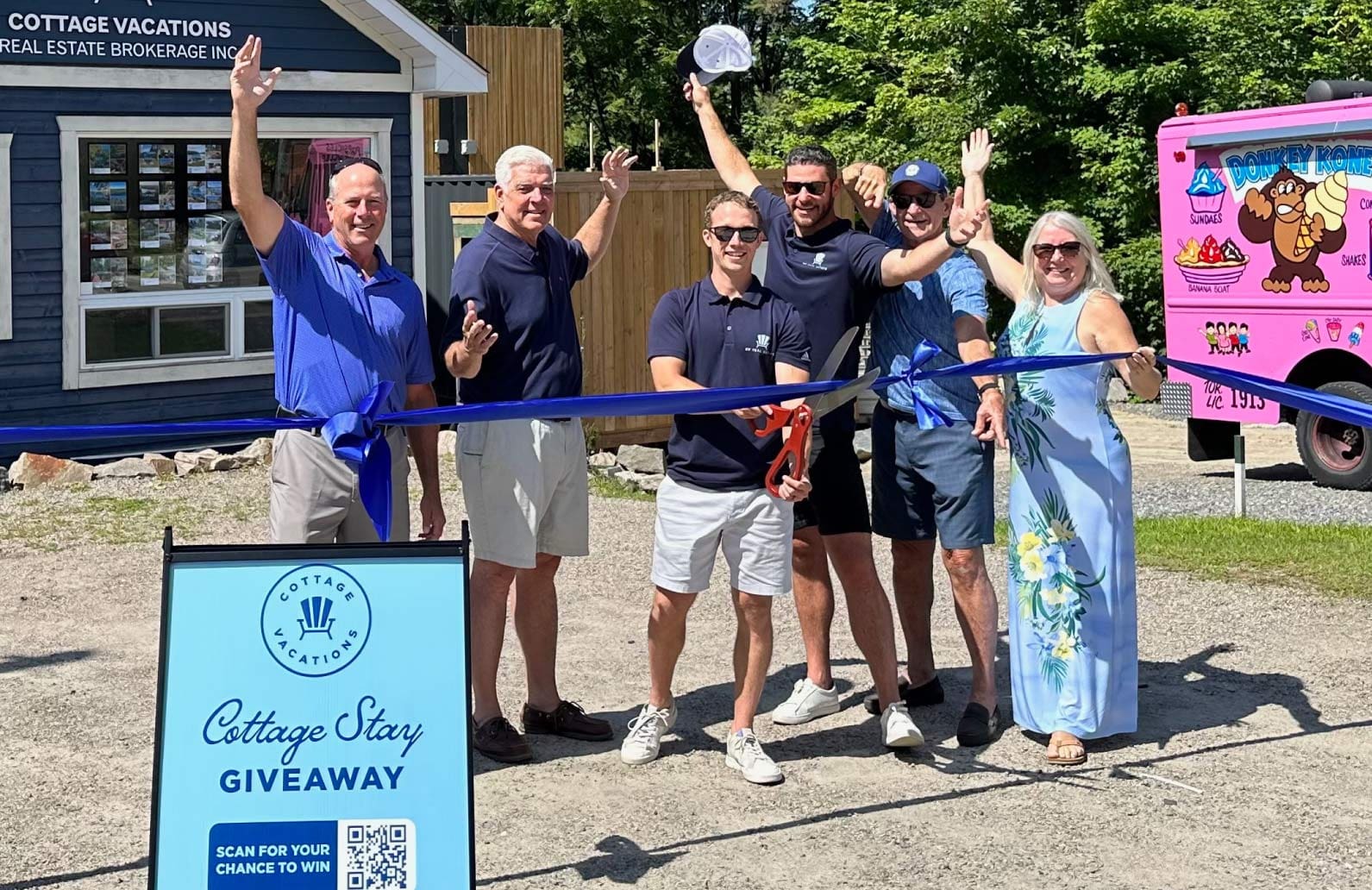
Meet The Team
We’re cottage country enthusiasts and vacation property experts, helping renters, buyers, and sellers reach their goals for more than 20 years.