
Comparing cottage real estate agents online requires looking at different data points than you would use to evaluate an urban residential agent. Sold records on comparable lakes, days on market relative to local averages, the depth of a digital presence focused on cottage country, and the quality of the listing descriptions they produce are more useful signals than star ratings or follower counts. This guide explains what to look for, where to find it, and what it means.
Why Does Comparing Cottage Agents Online Require a Different Approach?
Comparing cottage real estate agents online is more nuanced than comparing urban residential agents because the cottage market is specialized in ways that general metrics do not capture. An agent with a high transaction volume in a Toronto suburb has demonstrated skill in a competitive, high-liquidity market with abundant comparable sales data. That track record does not translate directly to a cottage country market where properties are unique, lakes have distinct buyer profiles, STR bylaw knowledge is material to investment decisions, and the sales cycle can extend over two years.
The relevant question when evaluating a cottage agent online is not “how many sales have they done” but “how many sales have they done on the specific lakes and in the price range where I am buying or selling.” A Muskoka specialist who has sold twenty properties on Lake of Bays and Lake Joseph in the past three years has demonstrated relevant expertise. An agent with a hundred urban transactions and two cottage sales does not, regardless of how their overall profile looks on a general agent directory.
The team at CV Real Estate operates exclusively in Ontario cottage country, with a specific focus on Muskoka, Haliburton, and Georgian Bay markets. That specialization is verifiable through the listings, sold properties, and market content published on the site. For buyers and sellers evaluating the team against other agents, the relevant comparison is on cottage-specific activity, not total transaction volume. The cottage agent questions resource outlines what to ask in any agent comparison.
What Online Sources Show Meaningful Cottage Agent Performance Data?
Several sources provide performance data that is meaningful for evaluating a cottage real estate agent in Ontario. Not all of them are equally useful, and some are more likely to mislead than inform.
REALTOR.ca is the most authoritative source for verifying that an agent is active and licensed in Ontario. It shows current and recently sold listings associated with the agent’s profile, which gives buyers a baseline view of the properties the agent has actually handled. For cottage agents, the relevant signal is whether the sold listings include waterfront properties in the specific lake regions you are interested in, not just the total count of transactions.
The Real Estate Council of Ontario (RECO) public register is the authoritative source for license status verification and enforcement history. This is distinct from performance data, but it is the foundation of any comparison. An agent who is not registered in good standing with RECO cannot legally trade in real estate in Ontario. The RECO register also shows any enforcement actions, discipline decisions, or conditions on a registration from the past five years. Running a RECO register check on any agent you are considering is a basic due diligence step that takes under five minutes.
|
Source |
What It Shows |
Limitation |
|
REALTOR.ca agent profile |
Active and sold listings; brokerage affiliation |
Does not show list-to-sale ratio or days on market |
|
RECO public register |
License status, brokerage, enforcement history |
Not a performance metric; verification only |
|
Google reviews |
Client satisfaction signals; specificity of feedback |
Cannot be verified as genuine; volume varies widely |
|
Agent’s own website / listings |
Market focus, content depth, active listings |
Self-curated; does not show performance data |
|
HouseSigma / Wahi (sold data) |
Historical sold prices by agent in specific areas |
Urban-skewed; cottage country data may be limited |
|
Cottage-specific platform activity |
Listing quality, lake knowledge, response time |
Harder to find; requires direct research |
How Do You Evaluate Sold Listings Data for a Cottage Agent?
Sold listings data is the most objective performance indicator available for real estate agents, and for cottage agents, it should be interpreted with lake specificity in mind. When reviewing an agent’s sold history on REALTOR.ca or through data platforms like HouseSigma, the relevant questions are: Which lakes are represented in their sold listings? What price ranges have they transacted in? Are the property types similar to what you are buying or selling (waterfront, year-round, seasonal, island)? How long did properties sit on the market before they sold?
Days on market is a particularly useful metric for sellers evaluating a listing agent. An agent whose sold properties consistently come in at or below the local average days on market is demonstrating effective pricing and marketing strategy. An agent whose properties consistently sit for twice the local average before selling is either overpricing consistently or underserving their listings through inadequate marketing. In Ontario’s current cottage market, where inventory is elevated and buyers are selective, the gap between well-marketed and poorly-marketed listings is significant in both time and final price, a pattern reflected in national benchmark data published through CREA’s housing market statistics and its companion CREA Stats portal.
List-to-sale price ratio is a related metric that shows how close a property’s final sale price was to its listing price. A consistent ratio above 95 percent signals good initial pricing and strong buyer engagement. A ratio consistently below 90 percent suggests the agent is either listing too high or failing to generate competitive interest. This data is not always accessible through public platforms for cottage country properties due to lower transaction volumes, but an agent should be able to provide it directly when you ask. Agents practicing in Ontario are also registered and subject to standards of conduct through the Ontario Real Estate Association (OREA).
What Does an Agent’s Digital Presence Reveal About Their Cottage Country Expertise?
A cottage real estate agent’s digital presence, including their website, social media activity, and published content, provides meaningful signals about the depth of their market knowledge and the seriousness of their specialization. These are qualitative signals rather than quantitative data, but they are often more revealing than star ratings for understanding whether an agent actually knows the market they claim to serve.
An agent who publishes detailed content about specific lakes, communities, and market trends demonstrates that they have earned knowledge through actual market experience. A blog post about the difference between buying on Lake Joseph versus Lake Rosseau, or an analysis of how By-law 2025-049 affects rental income on properties in the Township of Muskoka Lakes, tells a prospective client that the agent understands the nuances of the market at the level where transactions actually happen. Generic content about “tips for buying a vacation home” does not make the same case.
Social media activity that features actual listings, local events, market updates, and community knowledge is more credible than accounts that primarily repost motivational content or national real estate statistics. Look for an agent whose social presence reflects the specific lakes, communities, and property types you are interested in, and who demonstrates consistent activity over time rather than sporadic posting when a new listing goes live. The CV Real Estate team publishes lake-specific content across Muskoka, Haliburton, and Georgian Bay as a reflection of the team’s focus.
How Do Client Reviews Fit Into a Cottage Agent Comparison?
Client reviews are useful inputs in a cottage agent comparison, but they must be interpreted carefully. Review platforms including Google, RateMyAgent, and agent profiles on Zillow aggregate client feedback, but the quality of that feedback varies enormously. A review that says “great experience, would recommend” provides very little information about whether the agent has the specific expertise you need. A review that says “negotiated effectively on a Lake Joseph waterfront in a multiple-offer situation, understood the dock permit history and how it affected value” tells you far more.
For cottage agents, the most useful reviews are those that describe the specific type of property and transaction the reviewer experienced. Reviews from buyers or sellers of waterfront cottages in the specific lake regions you are targeting are meaningfully more relevant than reviews from urban transactions or from different regions. When reading reviews, look for specificity of praise, mentions of the agent’s lake or market knowledge, and any comments about the agent’s ability to navigate the specific complexities of a cottage transaction (due diligence, STR considerations, financing guidance).
Review count matters in context. An agent with three hundred reviews accumulated over ten years of urban residential practice is not necessarily better positioned for your Muskoka cottage purchase than an agent with forty highly specific cottage country reviews. The relevant sample is not all reviews; it is reviews from clients whose situations are comparable to yours.
What Should You Ask an Agent After Researching Them Online?
Online research narrows the field; direct conversation confirms the selection. After reviewing solid data, RECO registration, digital presence, and client reviews, the questions to ask a cottage agent before engaging them should probe the specific expertise their online presence suggests they have.
Ask how many properties they have sold on the specific lake or in the specific region where you are buying or selling in the past 24 months. Ask what their average list-to-sale price ratio has been on cottage country properties. Ask how they approach pricing in the current elevated-inventory environment, and what their typical marketing plan looks like for a waterfront property. Ask whether they understand the STR bylaw landscape in the specific municipality you are interested in, and how that affects the investment case for a buyer.
The cottage agent questions resource provides a comprehensive list of the questions that reveal whether an agent’s cottage country expertise is real or claimed. CV Real Estate welcomes these questions directly from buyers and sellers evaluating the team.
Finding an Agent Whose Track Record Matches Your Market
Comparing cottage real estate agents online starts with the right sources and ends with the right questions. Sold records on comparable properties, license verification through RECO, content depth that demonstrates genuine market knowledge, and client reviews that describe specific cottage transactions are the signals that matter. Generic agent directories and star ratings aggregate information that was collected for different markets and different property types; they should inform but not conclude your evaluation.
CV Real Estate operates exclusively in Ontario cottage country and publishes its market knowledge, team credentials, and current listing activity in detail. If you are comparing agents for a Muskoka, Haliburton, or Georgian Bay purchase or sale, the team is available for a direct conversation through the buying call or selling call links.
Frequently Asked Questions
1. What is the most reliable source for comparing cottage real estate agents in Ontario?
REALTOR.ca and the RECO public register are the most authoritative and reliable sources for verifying that an agent is licensed and active in Ontario. REALTOR.ca shows current and recent listings by agent. RECO shows registration status and any enforcement history. For performance data, an agent’s own sold listings on REALTOR.ca, combined with direct requests for list-to-sale ratios and days on market on comparable properties, provides the most relevant picture. The cottage agent questions resource covers what to ask beyond the online research.
2. How do I know if a real estate agent specializes in cottage country properties?
Genuine cottage country specialization shows up in an agent’s sold listing history (waterfront and recreational properties in specific lake regions), their published content (lake-specific market analysis and community guides), and the specificity of their client reviews (cottage transactions, not urban residential). An agent who claims cottage specialization but whose sold history is primarily urban residential has not demonstrated the relevant expertise, regardless of their total transaction count. For buyers evaluating the Muskoka market, the CV Real Estate team’s cottage country focus is verifiable through its listings, content, and client feedback.
3. Should I work with a local cottage country agent or a large urban brokerage?
For cottage country purchases in Ontario, a locally specialized agent consistently provides better transaction outcomes than an urban agent working outside their primary market. Local agents understand lake-specific value drivers, have established relationships with inspectors, appraisers, and other professionals in the area, and can access information about properties that may not be publicly listed. Large urban brokerages have brand recognition and marketing infrastructure, but the agent assigned to your file may not have the lake-specific knowledge your transaction requires. This is a decision worth researching carefully, and the cottage agent questions resource helps buyers evaluate any agent regardless of brokerage size.
4. How important are Google reviews when comparing cottage real estate agents?
Google reviews are useful signals but should not be the primary basis for selecting a cottage agent. The most informative reviews are those that describe specific cottage transactions on comparable lake properties, not generic satisfaction ratings. Review volume matters in context: a hundred urban reviews are less relevant than twenty specific cottage country reviews from buyers and sellers in the region you are targeting. Look for reviews that mention lake knowledge, due diligence guidance, STR bylaw awareness, or other cottage-specific expertise rather than general communication and service ratings. Reviews should inform your shortlist, not determine your final selection. Direct conversation and sold data are more reliable decision inputs.
5. What does a strong cottage agent digital presence look like online?
A strong digital presence for a cottage real estate agent in Ontario includes lake-specific and community-specific published content, current and sold listings that reflect genuine waterfront and recreational property activity, and client reviews that describe cottage transactions in detail. An agent website with detailed guides to specific lakes, municipalities, STR rules, and due diligence processes demonstrates earned knowledge. Social media that features actual local listings, community events, and market context is more credible than generic real estate content. The CV Real Estate insights section is an example of the type of market-specific content that demonstrates genuine cottage country expertise.
Key Takeaways
- Comparing cottage real estate agents online requires lake-specific sold data, not total transaction volume. The relevant question is how many comparable waterfront transactions the agent has completed in the specific region and price range.
- REALTOR.ca and the RECO public register are the most authoritative sources for verifying an Ontario agent’s license status, brokerage affiliation, and enforcement history.
- Days on market and list-to-sale price ratio on comparable cottage properties are more revealing performance metrics than star ratings or follower counts on general review platforms.
- Published content depth, including lake-specific market analysis, community guides, and STR bylaw knowledge, is a meaningful signal of genuine cottage country expertise that is visible and verifiable online.
- Client reviews from comparable cottage transactions are significantly more informative than generic satisfaction ratings; look for specificity about lake, property type, and transaction complexity.
- Online research narrows the field; direct conversation about specific sold data, pricing strategy, and STR bylaw knowledge confirms the selection before engaging a cottage agent.
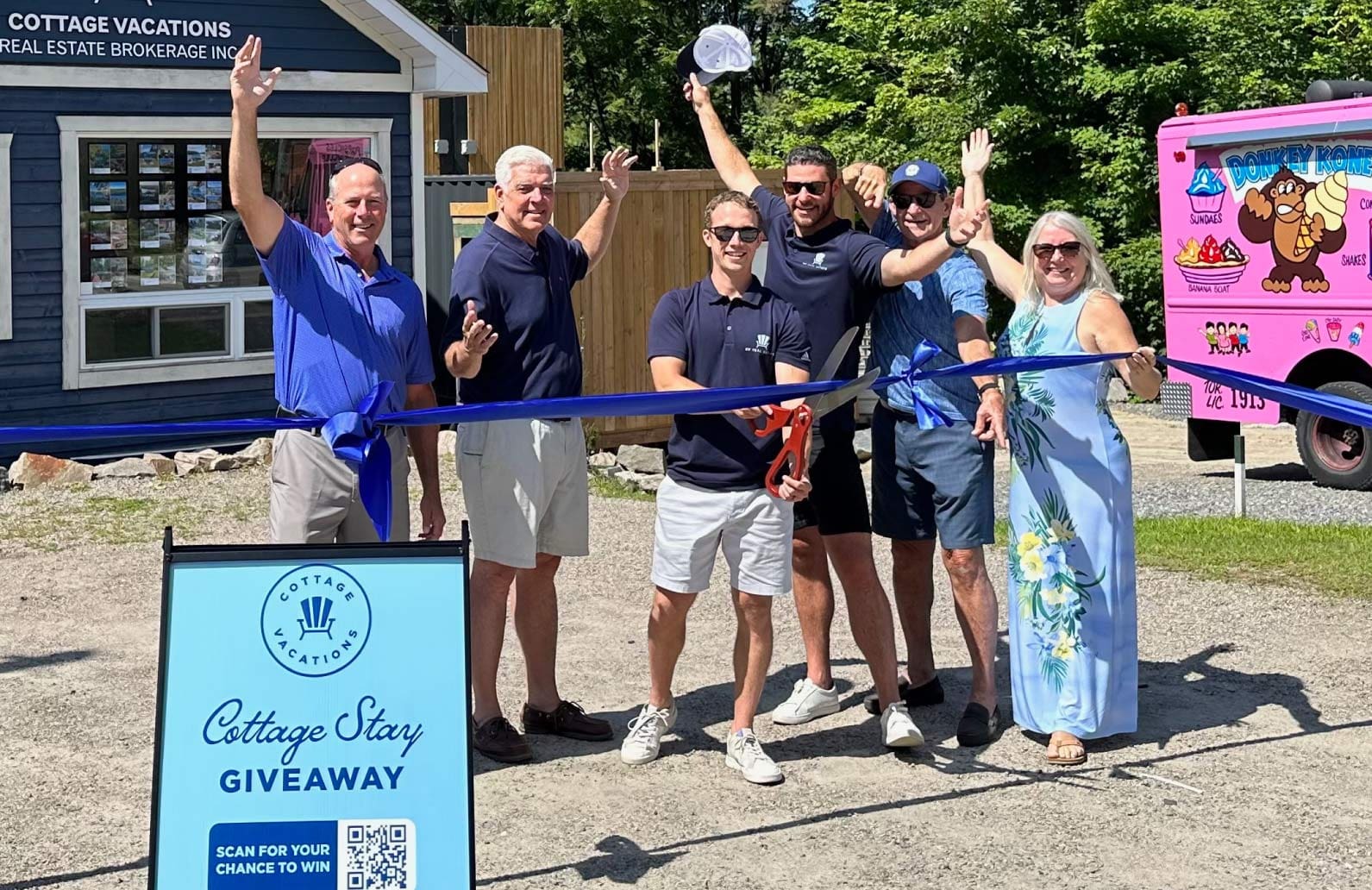
Meet The Team
We’re cottage country enthusiasts and vacation property experts, helping renters, buyers, and sellers reach their goals for more than 20 years.